
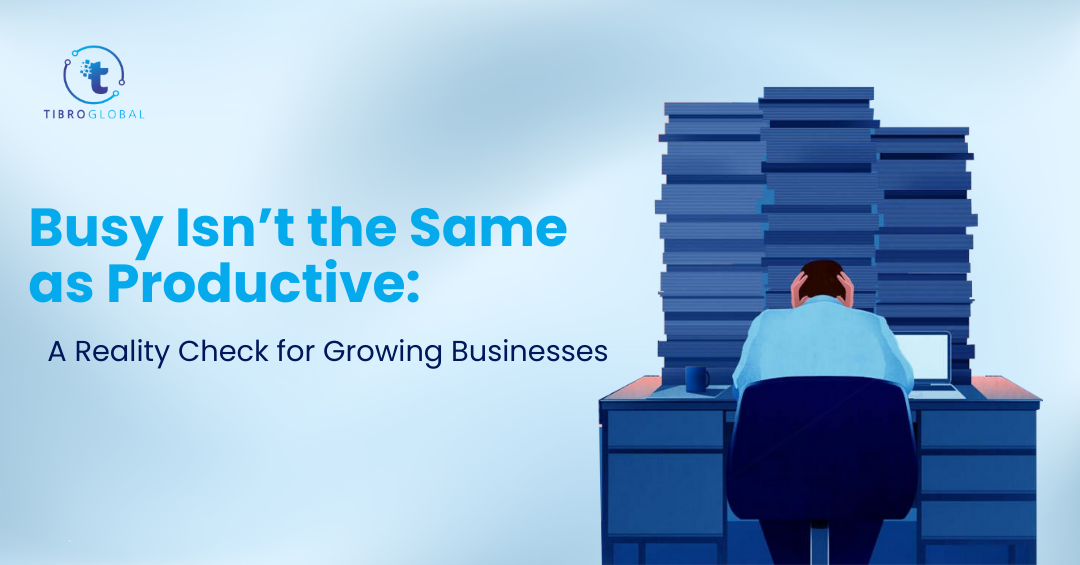
Busy Isn’t the Same as Productive: A Reality Check for Growing Businesses
Ask most business leaders how work is going and you’ll hear the same answer: busy.
Busy days. Busy teams. Busy weeks that somehow blur into months.
But busyness isn’t proof of progress. In fact, constant busyness is often a sign that business operations are stretched, unclear, or quietly working against the team. Understanding this distinction is one of the most important and overlooked steps in building a sustainable company.
The Productivity Trap
Many growing businesses fall into the same trap: equating activity with effectiveness.
More meetings. More emails. More tasks being checked off.
Yet results don’t always improve.
This is one of the most common operational challenges in growing businesses. Without deliberate process optimization, work expands to fill time instead of producing better outcomes. Teams work harder, not smarter, and fatigue sets in quickly.
Where Operations Start to Break
Operational issues rarely arrive dramatically. They creep in quietly.
Some early warning signs include:
- Tasks depending on one specific person
- Processes that exist only “in someone’s head”
- Repeated errors caused by unclear handovers
- Teams solving the same problem in different ways
These patterns are classic common operational mistakes in SMEs, and they become more costly as the business grows.
Why Operational Efficiency Is a Leadership Responsibility
Strong operational efficiency doesn’t come from tools alone. It comes from leadership decisions.
Leaders who build resilient teams consistently ask:
- “Is this process still serving us?”
- “Who owns this, clearly?”
- “What happens if someone is unavailable?”
These questions sit at the core of how to build efficient business operations. They shift the organization from reacting to planning, from urgency to clarity.
Growth Without Structure Is Fragile
Growth is exciting. New clients. More revenue. Bigger teams.
But without structure, growth becomes unstable. Small issues turn into major disruptions. Simple delays ripple across teams.
This is why scaling business operations effectively isn’t about speed, it’s about stability. Processes should absorb growth, not collapse under it.
What Well-Run Operations Have in Common
Across industries, high-performing operations tend to share the same foundations:
- Clearly documented processes
- Defined roles and expectations
- Repeatable workflows
- Visibility into ongoing work
- Accountability without micromanagement
These elements are essential for improving internal processes for business growth and reducing day-to-day friction.
The Tibro Global Perspective
At Tibro Global, our work places us inside real teams and real workflows. We see firsthand where business operations break down and where small structural changes make a big difference.
That exposure allows us to think beyond execution and focus on building systems that support calm, consistent performance. Ultimately, our work supports long-term operational efficiency, not just short-term output.
Final Thoughts
If your business feels constantly busy but rarely settled, the issue may not be effort or talent. It’s more likely operational.
Good operations don’t draw attention to themselves. They quietly make everything else easier.
And that’s often the difference between businesses that grow sustainably and those that simply stay busy.
Interested in building stronger, more reliable business operations?
Learn more about how Tibro Global supports smarter operations at www.tibroglobal.com.